Thursday, July 19, 2007
Kidsweek

Who Has Time to Blog?
Friday, April 27, 2007
Exclusion
People will say that their biggest obstacle to believing in Jesus, right after the “problem of evil,” is the exclusivity of Jesus (John 14:6). Is Jesus the only way to God? I overheard an interesting conversation of late where a professor argued that Jesus’ assertion “No one comes to the Father except through me” was not a statement of exclusivity (with the emphasis on only) but a statement of uniqueness (with the emphasis on me). Then, with a deft hermeneutical move over into Matthew’s gospel, the professor identified the “me” of Jesus as his solidarity with “the least of these” (Matt 25:40). Since “the least of these” (the outcast and the excluded) are thereby included, Jesus is saying that the only ones ever excluded from the kingdom are excluders. Granted there is a flaw in logic here: If indeed Jesus excludes excluders, that makes Jesus an excluder and he thereby excludes himself (but I digress). Christians struggle as much as nonbelievers with this claim of Christ. Is he simply saying that saying that salvation is only possible through him (an ontological claim, Acts 4:12)? Or is Jesus also asserting that a person must know him to gain access to God (an epistemological claim and the cause of much missionary anxiety)? I heard another workaround that went like this: “Jesus is the only way to God, but there may be many ways to Jesus.” Author Annie Dillard told the tale of a missionary who approaches an Eskimo and shares the gospel. The Eskimo asks, “Are you saying that my rejection of this message constitutes my damnation?” The missionary responded yes. The Eskimo replied, “Then why did you tell me?” Christianity is based on the reality of God incarnate in Christ. This is how God so loved the world (John 3:16). But some will wonder: Is it love if most of the world has historically been unable to know it?
Thursday, March 22, 2007
Rent to Own
Sunday, March 11, 2007
The Upside of Hypocrisy

It was the 17th century French writer, Francois de La Rochefoucauld, who first suggested the upside to hypocrisy when he quipped, “Hypocrisy is the homage vice pays to virtue.” His point, I think, was that at least when you’re a hypocrite, the morality you’re faking at least looks like morality. Al Gore can get caught consuming 20 times the national average of electricity in his 20-room home, but at least his message against global warming gets heard. Mitt Romney can do his chameleon bit as he races from Blue State to Red State, but at least issues of social significance get debated. The Pharisees could cheat their way around the Ten Commandments and fail to practice what they preached, but at least they preached it. Yet hypocrisy infuriated Jesus almost more than anything else. Why? Is it because God (who alone is able to see the heart) is forced to look at all our inconsistencies? We know that being saved by grace hardly makes any of us sin-free; if anything, it makes the sins we continue to commit seem even worse. Would it be better to let our true selves show instead of trying to keep up appearances? Honesty and humility are the only cures for hypocrisy (empowered by that same grace), but we Christians still haven’t managed to figure how to help one another pull down our masks and risk it. We’re just too afraid of what we’ll see; or worse, we’re too afraid of what others will see in us. Best to leave the darkness of our hearts to the eyes of God?
Tuesday, February 27, 2007
Oscar Night

I imagine many church folks made it home in time to watch Marty finally get his Best Director Oscar for his bloody Boston movie (which by the way is hardly what Southie is like these days). I was interested in Jennifer Hudson's acceptance speech, given her unabashed profession of faith. I have to admit it made me cringe a bit. Not because I don't appreciate whenever public figures are genuine believers (which I understand Miss Hudson to be); it's just that the Hollywood setting for any profession of faith is just so, well, ironic. Given the material and self-serving values of show business, not to mention the showiness, I don't know, I'd just prefer to leave Jesus out of it. Granted, the movies are a powerful medium. And I like when faith is portrayed on screen in un-caricatured fashion, as with the current film Amazing Grace (though we are talking 18th-early 19th century in his case). Still, Narnia and The Passion included (especially once you throw in Mel Gibson's after-antics), movies are still for the most part entertainment more than anything. And I can't help but struggle with making an honest connection between faith and entertainment, given that faith will most times get the short end of the stick. Except in the rarest instances (namely, when the need to make a profit is not at stake), making Holywood out of Hollywood is a long, long reach.
Friday, July 07, 2006
Time Flies by Daniel Harrell
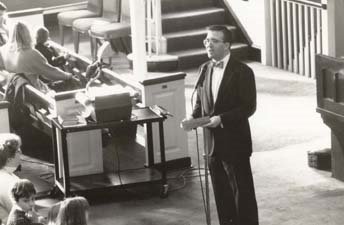
How long should a minister stay at one church? This is a question that I bat around as I mark 20 years at Park Street. It's said that the average tenure of a pastor in any one church is 3-5 years max. By that time, the call of the career ladder, the emergence of conflict or boredom take hold. On the one hand, a new minister brings new hope and new possibilities. We all love the promise that comes with a new relationship. However, as experience also shows, it's not long before old personality traits and habits surface. Soon we're back where we were before; looking for greener grass (and a greener minister). On the other hand, a long term pastorate forces the erosion of masking layers. Idealizations dissolve and pedestals crumble. The hard personalities of both congregation and minister that remain present real opportunities for Christian love. The minister who moves from place to place can hide his sinful side. The minister who stays has to serve with his or her sinful side exposed relying not on his or her ability, but solely on God's grace. I'll admit that there are days when leaving feels like the solution to disappointment, conflict or the lure of novelty. But in the end I've found that only through staying is my own soul hewn into more obedient shape. When a congregation and a minister can work together and for each other as one body of Christ, the outcomes are real spiritual growth, genuine Christian love and authentic Christian witness.
Thursday, January 05, 2006
"The Wink of an Eye" by Daniel Harrell
“Whoever winks the eye causes trouble, but the one who rebukes boldly makes peace.” (Proverbs 10:10; NRSV rather than the NIV) Solomon is not denouncing winking per se, but winking at as in “pretending not to see.” There was this Midwest mega-church which right after completing their “phase-one-58-million-dollar-building-project” had their Senior Pastor publicly acknowledge an illicit affair he’d been having with the church secretary. “Ah, what else is new?” you skeptically think. Yet what makes this particular story more disturbing and sad is how church elders knew about the senior minister’s sin but “winked at it” rather than jeopardize the building project’s completion. The neighboring community responded by shaking its collective head, chalking up the whole scandal as yet one more reason to stay home and watch football on Sundays. Granted, it would have been awkwardly unpleasant for somebody to have gotten into this minister’s face; but if anybody had really cared about the man or about the church, they should have done it. Maybe the problem was that nobody really cared. Or maybe nobody wanted to be the heavy. It is much easier to just let things slide. That way at least you get to relish the gossip (and we do love gossip). Besides, who am I to correct you? Isn’t that the Holy Spirit’s job? Yes. But since when do Christians listen to the Holy Spirit? And who’s to say that you can’t be the hand the Holy Spirit uses to smack somebody upside their head? Such confrontation does take courage. Which is why Solomon used the adverb “boldly” alongside rebuke. However Solomon is not granting permission to get all judgmental and legalistic. This proverb is about peacemaking; peacemaking which goes beyond glib notions of personal anxiety relief to the hard reality of confronting another’s sin for the sake of the shalom of God. A bold rebuke should be like sunlight. It unambiguously exposes the wrong yet also provides the warmth required for repentance and forgiveness and reconciliation to occur. If you care about somebody you don’t wink at their sin, you muster enough courage to smack them upside their head. But you then take that same hand and guide them back onto the right road—a road you’re more than willing to travel alongside them. Does this happen in our own communities?
"In The Beginning" by Daniel Harrell

The opening verses of Genesis are among the most powerful of all Scripture: “In the beginning God created the heavens and the earth…” They provide the core of our faith and hope. Of course Genesis doesn’t spell out specifically how God created, at least not in any scientific fashion, which has led to ongoing debates over evolution, creationism and intelligent design. Regrettably, as Fuller Seminary’s Nancey Murphy observes, “Vast numbers of young people are taught that evolution and Christianity can’t both be true. They get a good science education in college, recognize the truth of the evolutionary picture, and then believe that they have to reject their faith.” I spent the Christmas holiday reading Kenneth Miller’s Finding Darwin’s God, a persuasive tome on the interrelatedness of faith and evolution by a Christian and cell biologist from Brown University. He makes the case that quantum indeterminacy and the anthropic principle provide plain scientific space for the plausibility of God and that evolution itself should be viewed as evidence of God’s own competent creative power. “If God exists,” Miller writes, “He acts in the world today in concert with natural laws and works his will in the present through contingent events of human and natural history. All that evolution does is point out that the workings of natural processes are sufficient to explain the contingent events of natural history in the past, including the origin and extinction of species. There is neither logical nor theological basis for excluding God’s use of natural processes to originate species, ourselves included. There is therefore no reason for believers to draw a line in the sand between God and Darwin.” As to miracles, they are just that: miracles. If all truth ultimately resides with God who was “in the beginning,” then theology need not be pitted against science nor accommodated to science. “If we can see the hand of God in the unpredictable events of history and we can see meaning and purpose in the challenges and trials of our daily lives,” Miller argues, “then we can certainly see God’s will in the grand and improbable tree of life.” What do you think?